New paper on phase field crystal modeling of grain boundary migration
A new paper, titled Phase Field Crystal Modeling of Grain Boundary Migration: Mobility, Energy and Structural Variability, was recently published in Acta Materialia.
Abstract
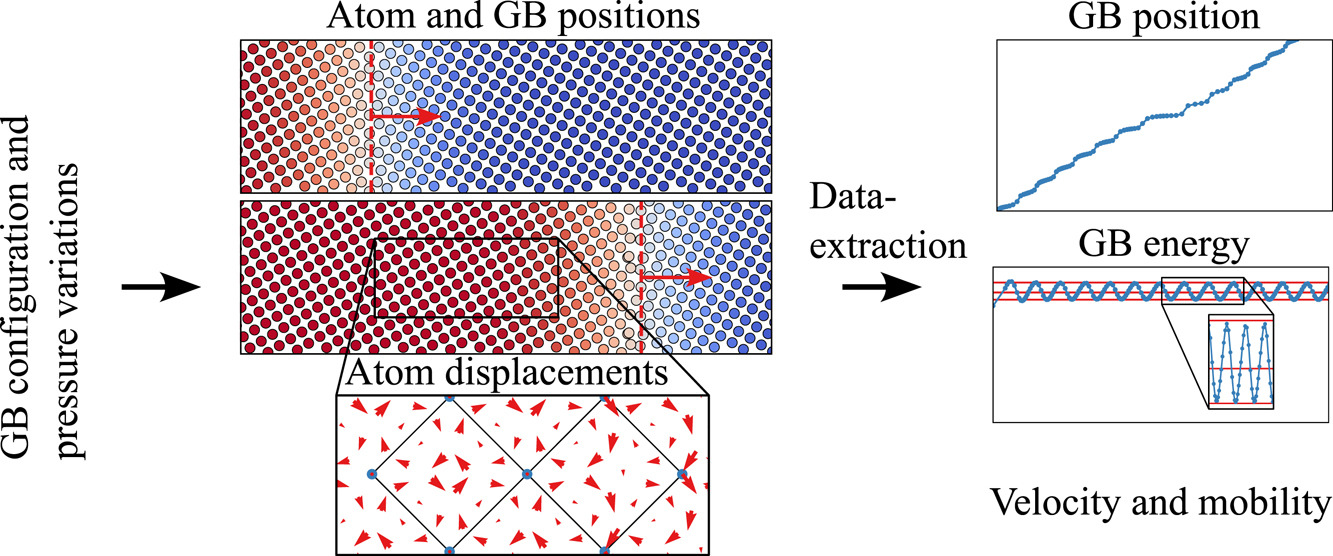
Phase field crystal (PFC) modeling is employed to investigate the migration dynamics of FCC and BCC symmetric tilt grain boundaries (GBs) under an applied artificial driving pressure. The evolution of GB position, velocity, mobility, structure and energy is tracked to explore the interdependencies of these quantities. The use of PFC permits simulations with atom scale spatial resolution over extended migration distances, beyond what is readily achievable using molecular dynamics (MD) simulation. Consistent with MD-based data in the literature, the PFC results reveal a nonlinear dependence of GB mobility on driving pressure. Additionally, GB mobility exhibits a nonlinear dependence on misorientation, which correlates with energy variations observed in the migrating GBs. These energy variations also align with GB energy fluctuations associated with structural multiplicities in static boundaries, as recently demonstrated by the authors using PFC in Hallberg and Blixt (2024). Notably, the relation between GB mobility and minimum GB energy transitions between different types of covariance in different pressure regimes. These findings provide new insights into the complex mechanisms governing GB migration and demonstrate the capability of PFC modeling as a tool to capture GB dynamics beyond the time scale limitations of conventional MD simulations.